



7 Best Music Distribution Services in 2026: Features, Pricing & Comparison
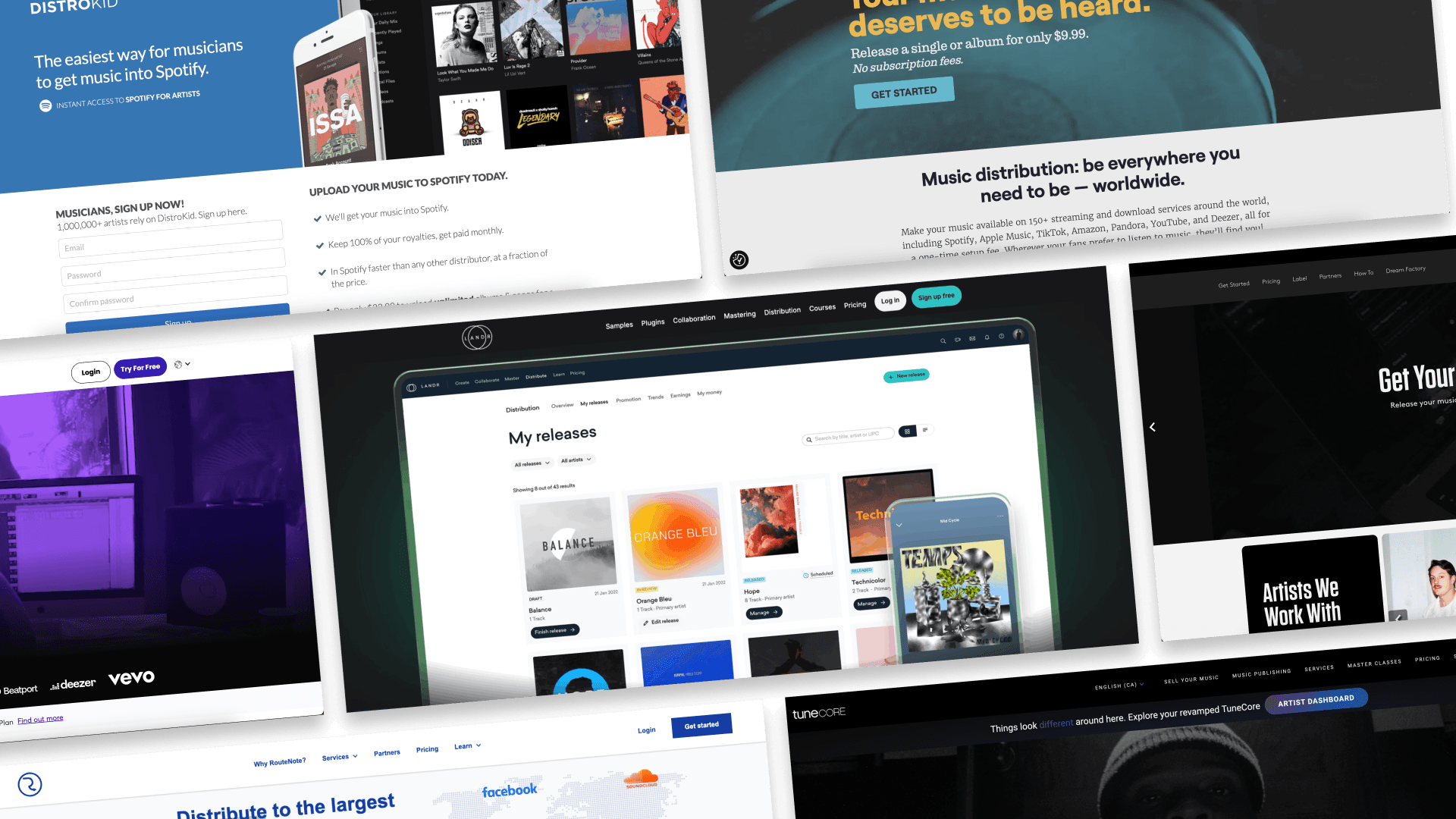
Choosing the right music distribution service is an important decision for any independent artist.
Music distributors get your songs onto streaming platforms like Spotify and Apple Music, collect royalties, and provide tools for managing your releases. However, pricing and features vary, with some charging subscriptions or taking a percentage of royalties and others charging extra for services like YouTube Content ID, cover song licensing, or keeping your music online after cancellation.
We’ve compared seven leading music distribution services in 2026, looking at their pricing, features, royalty policies, and overall value for independent artists.
Here’s what you need to know before releasing your next track.
Key takeaways: Which music distributor should you choose?
Here are the key takeaways of each distributor along with their entry-level pricing.
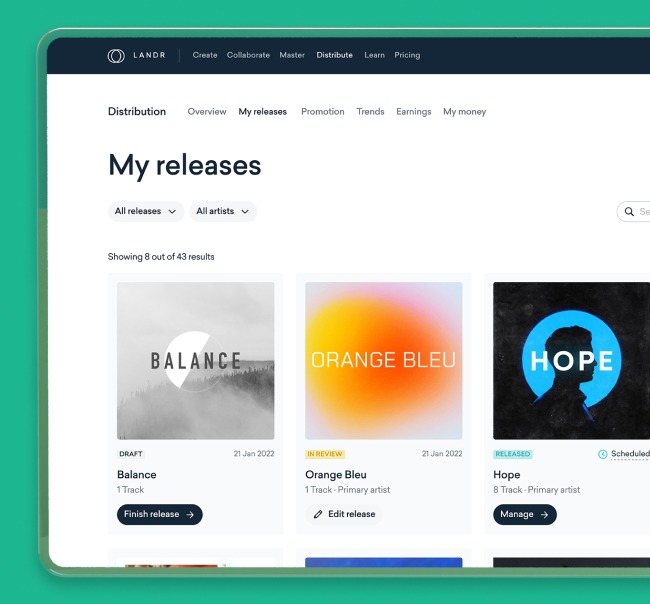
LANDR combines full-featured distribution with music production tools, promotional features, and access to artist funding for eligible musicians. Good for artists who want to manage more of their creative and release workflow in one place. Pricing begins at $24/year.
TuneCore combines entry-level release scheduling with optional publishing administration and sync licensing services. It suits artists who want to coordinate releases with promotional campaigns and access additional songwriting royalty collection. Pricing begins at $24.99/year.
CD Baby suits musicians who release occasionally and prefer one-time payments. Its optional CDB Boost service provides additional royalty collection and sync opportunities. Pricing begins at $9.99/single.
Ditto offers unlimited distribution with essential release-management tools and access to publishing and sync services through higher-tier plans. Pricing begins at $19/year.
Amuse offers release-management tools, analytics, and potential royalty advances for eligible artists, alongside additional promotional tools. Pricing begins at $23.99/year.
DistroKid offers unlimited distribution with optional publishing administration for eligible songwriters. Pricing begins at $24.99/year.
RouteNote offers unlimited distribution without upfront costs and the option to move individual releases to commission-free Premium distribution for a per-release fee. This means that the base plan is free.
Starting prices in USD as of November 2026. Some features and services mentioned require higher-tier plans, separate purchases, or eligibility.
How we compared the services
We evaluated each distributor’s core features, pricing, additional services, and long-term value for independent artists.
Our criteria included distribution reach, Content ID and social monetization, unlimited releases, release scheduling, analytics, royalty splits, promotional tools, cover song licensing, catalog retention, catalog migration, and AI music acceptance.
We also considered additional offerings, such as publishing administration, sync licensing, and music production tools, along with their costs and limitations.
The reasons to consider each service may include optional upgrades or separately purchased offerings, not just features included at the listed starting price. The right choice depends on your budget, release habits, and the services you need.
Now let’s take a closer look at each distribution service.
1. LANDR
| LANDR | |
|---|---|
| Starting price | $24/year for unlimited distribution; Studio from $99/year |
| Distribution commission | 0% commission on streaming royalties while subscribed |
| Content ID & social media | Included in Distribution Pro & Studio; 20% commission |
| Royalty splits | Included |
| Release scheduling | Custom dates on Distribution Pro and higher |
| Publishing admin | Not offered |
| Cover song licensing | $15/cover, one-time fee |
| AI music policy | Accepted with limits |
| Additional features | Promotional tools, royalty splits, Cover Art Assistant, artist funding for eligible artists; AI mastering, plugins, samples, and more with Studio |
| Catalog migration | Dedicated release importer; ISRC retention; large-catalog assistance |
| Catalog retention | Music stays online after cancellation; 15% commission on streaming royalties |
LANDR is great for independent musicians looking for affordable, full-featured distribution with the option to access a broader range of music production tools.
Starting at $24/year, LANDR Distribution includes unlimited releases to major streaming platforms, YouTube Content ID and social monetization, royalty splits, promotional tools, and human support. LANDR takes a 20% commission on Content ID and other UGC fingerprinting royalties.
They’ve built a support team that is artist-focused and very knowledgable in music distribution, production, and promotion, helping artists navigate release reviews, catalog migration, and other issues that can arise when getting music onto streaming platforms. Premium support is available on higher-tier plans.
Additionally, LANDR offers a dedicated importer for transferring an existing catalog from another distributor, while their royalty split feature allows collaborators to collect earnings without the separate fee Amuse charges recipients who aren’t subscribers.
LANDR also offers eligible artists access to royalty advances through LANDR Artist Funding, powered by beatBread. Artists can explore funding based on their streaming history and use it for recording, touring, promotion, and other career expenses. As always, artists retain ownership of their music, while royalties from selected recordings go toward recoupment under the agreed terms.
More than just music distribution
What distinguishes LANDR is the option to combine distribution with a broader collection of production tools through LANDR Studio.
For artists who already pay for mastering, plugins, or sample libraries, Studio brings these resources together under one subscription. LANDR also offers a Cover Art Assistant on all plans except Distribution Basic.
This gives artists the flexibility to choose standalone distribution or a more complete music creation and release toolkit.
Another advantage is long-term catalog flexibility. Your music stays online even if you cancel your subscription, with a 15% commission applied to streaming royalties afterward, compared with Amuse’s 25%.
Bottom line: LANDR combines affordable, full-featured distribution with the option to access an integrated suite of music production tools. It’s particularly appealing to artists who want to manage more of their creative and release workflow in one place.
Compare LANDR Distribution and Studio plans
Back to top ⬆️
2. TuneCore
| TuneCore | |
|---|---|
| Starting price | $24.99/year for unlimited distribution |
| Distribution commission | 0% commission on streaming royalties while subscribed |
| Content ID & social media | Included; 20% commission |
| Royalty splits | Included |
| Release scheduling | Custom release dates available |
| Publishing admin | $75 one-time setup per songwriter; 20% publishing commission; 50% sync commission |
| Cover song licensing | Via licensing partner: $17 limited or $70 standard license, plus applicable charges |
| AI music policy | Accepted with limits |
| Additional features | Cover Art Creator, LinkShare, Accelerator, pre-save campaigns |
| Catalog migration | Manual transfer; ISRC and UPC retention |
| Catalog retention | Releases removed after canceled paid term expires |
TuneCore offers unlimited music distribution starting at $24.99/year, with custom release dates included in its entry-level Rising Artist plan.
This makes it worth considering for artists who want to coordinate releases with promotional campaigns without paying for a higher-tier subscription.
TuneCore also offers a pay-per-release option, although its fees renew annually rather than being one-time payments like CD Baby’s.
Publishing administration and additional services
Beyond distribution, TuneCore offers a separately purchased publishing administration service that helps songwriters collect royalties generated by their compositions, with optional sync licensing.
TuneCore Publishing Administration costs $75 per writer to set up and takes a 20% commission on publishing royalties collected. Synchronization licensing earnings are subject to a separate 50% commission.
This provides an option for artists who want publishing royalty collection alongside distribution. DistroKid now offers a separately purchased publishing administration service with eligibility requirements, while Ditto includes publishing and sync services on higher-tier plans. CD Baby provides more limited royalty collection through CDB Boost.
TuneCore also offers a Cover Art Creator on Breakout Artist and Professional plans. Cover song licensing is available through a partner, with Limited licenses starting at $17 and Standard licenses at $70, plus applicable additional charges.
TuneCore requires ongoing payment to keep releases available. If you cancel your Unlimited Plan, your music is removed from streaming platforms when your subscription expires.
Bottom line: TuneCore is worth considering for its entry-level release scheduling and separately available publishing and sync services. However, its licensing costs and ongoing payments to maintain releases are important tradeoffs.
Back to top ⬆️
3. CD Baby
| CD Baby | |
|---|---|
| Starting price | $9.99/single; $14.99/album, one-time payment |
| Distribution commission | 9% commission on streaming royalties |
| Content ID & social media | Included; 30% commission |
| Royalty splits | Not offered |
| Release scheduling | Release dates available; allow time for review and delivery |
| Publishing admin | U.S. mechanical royalty collection via CDB Boost |
| Cover song licensing | Not offered |
| AI music policy | Not accepted |
| Additional features | HearNow, Show.co; royalty collection and sync opportunities through CDB Boost |
| Catalog migration | Manual transfer; original ISRCs; switching discount |
| Catalog retention | Music remains online without annual distribution renewals; standard commissions continue |
CD Baby is one of the longest-running independent music distribution companies, having helped artists sell and distribute music since 1998.
Unlike most distributors on this list, CD Baby charges a one-time fee per release rather than an annual subscription. Your music remains available without renewal payments, making it particularly appealing to artists who release occasionally.
In exchange, CD Baby takes a 9% commission on standard streaming and download royalties. Social video monetization is also available, subject to a separate 30% commission.
For artists with modest streaming revenue, these commissions may be a reasonable tradeoff for avoiding annual fees. However, a subscription-based distributor that doesn’t take a cut of standard royalties may become more economical as earnings grow.
Additional royalty collection services
CD Baby offers CDB Boost, a $39.99-per-release add-on that provides access to U.S. mechanical royalty collection through The MLC, SoundExchange royalty collection, and sync licensing opportunities.
CDB Boost is more limited than CD Baby’s former Pro Publishing service, which was discontinued in 2023. It doesn’t replace comprehensive global publishing administration.
CDB Boost also involves additional commissions, including 15% on royalties collected through The MLC and 40% on sync licensing earnings.
Bottom line: CD Baby is a strong option for musicians who release occasionally and prefer one-time distribution payments. Its optional royalty collection services offer additional opportunities, although ongoing commissions may make it less economical for artists generating significant revenue.
Back to top ⬆️
4. Ditto Music
| Ditto Music | |
|---|---|
| Starting price | $19/year for unlimited distribution |
| Distribution commission | 0% commission on streaming royalties while subscribed |
| Content ID & social media | Included on Pro and Labels; 0% Content ID commission |
| Royalty splits | Included |
| Release scheduling | Custom release dates on Starter; exact times on Pro |
| Publishing admin | Included on Pro and Labels |
| Cover song licensing | Not offered |
| AI music policy | Accepted with limits |
| Additional features | AI Artwork Generator, SmartLinks, analytics, sync pitching |
| Catalog migration | Manual transfer; ISRC retention; support assistance |
| Catalog retention | Release Protection keeps music live; extra cost on Starter, included on Pro and Labels |
Ditto Music offers a relatively straightforward distribution subscription, with unlimited releases, royalty splits, custom release dates, and basic promotional tools.
Its entry-level Starter plan focuses on the essentials, while higher-tier subscriptions provide additional services. Ditto Pro and Labels plans include publishing royalty collection and opportunities to pitch tracks for film and TV sync licensing. These plans also include YouTube Content ID monetization without a Content ID commission.
Ditto also offers an AI Artwork Generator with a monthly allotment of image generations.
One important consideration is what happens when your subscription ends.
Under Ditto’s standard terms, the company instructs streaming platforms to remove releases within 30 days of contract termination.
However, Release Protection can keep music available after cancellation. This feature is included with Pro and Labels subscriptions, while Starter subscribers can purchase it separately for individual releases.
As of writing this comparison, Ditto doesn’t publicly specify the cost of Release Protection for Starter subscribers or whether additional commissions apply to protected releases after cancellation. Artists also need an active subscription to withdraw royalties.
Bottom line: Ditto offers unlimited distribution with essential release-management tools and the option to expand into publishing and sync services. However, higher-tier restrictions and the additional cost of Release Protection are important considerations.
Back to top ⬆️
5. Amuse
| Amuse | |
|---|---|
| Starting price | $23.99/year for unlimited distribution |
| Distribution commission | 0% commission on streaming royalties while subscribed |
| Content ID & social media | Included; 15% Content ID commission on Artist, 0% on higher tiers |
| Royalty splits | Included |
| Release scheduling | Scheduled dates require at least 14 days on some plans |
| Publishing admin | Not offered |
| Cover song licensing | $14.99/cover, one-time fee; via Easy Song Licensing |
| AI music policy | Accepted with limits |
| Additional features | Artwork generator, Share Links, artist bio pages, AI mastering |
| Catalog migration | Dedicated importer; ISRC retention |
| Catalog retention | Music stays online after cancellation; 25% royalty commission; 15% split fee |
Amuse offers unlimited music distribution starting at $23.99/year, with custom release dates, streaming analytics, and promotional tools available to independent artists.
Beyond distribution, Amuse offers eligible artists advances against anticipated future royalties. Offers depend on streaming activity and include fees and repayment conditions. Advances aren’t guaranteed or included as a standard subscription benefit, and certain distribution rights are restricted until the advance and associated fee have been recovered.
Amuse charges a 15% commission on Content ID royalties on its Artist plan, while higher-tier plans have no Content ID commission.
Amuse also advertises fast release processing, although actual availability depends on streaming platforms’ review times. Scheduled dates require at least 14 days of lead time on some plans.
Higher-tier subscriptions add support for multiple artists, fan email collection, hi-res audio distribution, and priority customer service. Additional offerings include AI mastering, Groover playlisting support, and an artwork generator available above the entry-level Artist plan.
Amuse also offers cover song licensing as a $14.99 per-track add-on through Easy Song Licensing. Licensing requirements differ by store and territory, so artists should check the coverage and conditions before distributing a cover.
What happens if you cancel Amuse?
One advantage of Amuse is that your music stays online even after you cancel your subscription.
However, Amuse applies a 25% commission to royalties once your subscription expires. You also lose access to certain features, including YouTube Content ID monetization and streaming analytics.
Amuse charges a 15% fee on royalty splits paid to collaborators without a subscription. A separate 15% fee also applies to splits on upcoming royalties after cancellation. LANDR, by comparison, provides free collaborator accounts for royalty splits and applies a lower 15% post-cancellation streaming royalty commission.
Bottom line: Amuse is worth considering for its release-management tools, analytics, and potential royalty advances for eligible artists. However, advance fees, collaborator fees, and its higher post-cancellation commission are important considerations.
Back to top ⬆️
6. DistroKid
| DistroKid | |
|---|---|
| Starting price | $24.99/year for unlimited distribution |
| Distribution commission | 0% commission on streaming royalties while subscribed |
| Content ID & social media | Paid add-on ($4.95/single/year or $14.95/album/year); 20% commission |
| Royalty splits | Included; collaborator account/payment conditions may apply |
| Release scheduling | Custom release dates on higher-tier plans |
| Publishing admin | $75 one-time setup per songwriter; 20% publishing commission; eligibility requirements apply |
| Cover song licensing | $12/cover, charged yearly |
| AI music policy | Accepted with limits |
| Additional features | HyperFollow, DistroPic image generator, lyrics and promotional tools |
| Catalog migration | Manual transfer; ISRC retention |
| Catalog retention | Releases generally removed when subscription ends unless Leave a Legacy is purchased ($29/single; $49/album) |
DistroKid is an established distribution service popular with independent musicians who release singles and other projects frequently.
Its annual subscription includes unlimited uploads and no commission on standard streaming royalties, making it appealing to artists who regularly release music and don’t need many optional features.
However, some useful tools, including customizable release dates, daily streaming statistics, and custom label names, require more expensive plans.
DistroKid also charges separately for services that other distributors may include. Its Social Media Pack, which includes YouTube Content ID monetization, costs $4.95 per single or $14.95 per album annually, plus a 20% commission on applicable advertising revenue.
Cover song licensing costs another $12 per cover annually, while other optional features carry additional recurring fees.
These expenses can add up for artists with larger catalogs.
DistroKid also offers publishing administration through a new service powered by Kobalt, helping eligible songwriters collect composition royalties worldwide. It costs $75 per songwriter to set up, plus a 20% commission on royalties collected. Eligibility requires at least one DistroKid release and more than $50 in streaming revenue over the previous 12 months.
What happens if you cancel DistroKid?
DistroKid generally removes your music from streaming platforms when your subscription ends, unless you’ve purchased its Leave a Legacy feature.
Leave a Legacy costs $29 per single or $49 per album containing two or more tracks. It’s a one-time purchase, but applies to individual releases rather than an entire catalog.
Artists who want to maintain multiple releases without an ongoing subscription must purchase it separately for each one.
Recent legal issues and artist concerns
DistroKid has also faced scrutiny over its content review and takedown practices.
In September 2026, Universal Music Group sued the company over alleged copyright infringement and deceptive business practices involving unauthorized and AI-generated recordings.
DistroKid disputes the allegations but has acknowledged removing recordings in response to UMG’s claims.
Subsequent Rolling Stone reporting documented independent artists who said their original music had been unexpectedly removed from streaming platforms, sometimes affecting their royalty payments.
These developments highlight the importance of understanding a distributor’s content policies, customer support, and procedures for resolving release issues.
Bottom line: DistroKid offers unlimited distribution that may suit artists releasing music frequently. However, additional feature costs, catalog-retention fees, and recent concerns surrounding release removals warrant careful consideration.
Back to top ⬆️
7. RouteNote
| RouteNote | |
|---|---|
| Starting price | Free unlimited distribution; Premium $10/single initially, $9.99/year renewal |
| Distribution commission | Free: 15% commission; Premium: 0% commission on streaming royalties |
| Content ID & social media | Included subject to eligibility; 15% commission on Free, 0% on Premium |
| Royalty splits | Included on Free and Premium |
| Release scheduling | Custom release dates on Free and Premium; same moderation process |
| Publishing admin | Available separately; 15% publishing commission |
| Cover song licensing | Not offered |
| AI music policy | Accepted with limits |
| Additional features | PUSH.fm smart links, pre-saves and bio pages; analytics |
| Catalog migration | Manual transfer; ISRC and UPC retention |
| Catalog retention | Free releases stay online with an active account; Premium can downgrade to Free |
RouteNote offers unlimited music distribution without upfront payments or annual subscription fees through its Free plan.
Artists can distribute singles, EPs, and albums to major streaming platforms while accessing royalty splits, custom release dates, basic analytics, and other essential tools.
Instead of charging upfront, RouteNote takes a 15% commission on streaming and download royalties, meaning artists retain 85% of the revenue it collects.
This makes its Free plan appealing to musicians releasing their first tracks, experimenting with distribution, or working with a limited budget.
RouteNote Premium
RouteNote also offers Premium distribution with per-release pricing for artists who want to retain 100% of standard streaming and download royalties.
Both Free and Premium provide the same core distribution features, including access to stores, release scheduling, and the same moderation process. The primary difference is the payment model and royalty share. Content ID monetization is subject to eligibility and follows the same commission structure: 15% on Free and 0% on Premium.
Artists can downgrade individual Premium releases to Free, avoiding future renewal fees in exchange for the standard 15% commission.
Free releases remain online without annual payments as long as the account stays active. Closing the account, however, results in music being removed from stores.
Bottom line: RouteNote offers an accessible way to distribute music without upfront costs, with the option to move individual releases to commission-free Premium distribution. Its 15% Free-tier commission is the main tradeoff as royalty earnings grow.
Back to top ⬆️
Which music distributor is the best?
There’s no single distributor that’s right for every artist.
If you want to avoid upfront costs, RouteNote Free is worth considering. CD Baby may suit occasional releases without an annual subscription, while TuneCore and Ditto offer different approaches to publishing and sync services.
For musicians looking to combine distribution with music production tools, LANDR offers a fully integrated platform.
Starting at $24/year, LANDR Distribution includes unlimited releases, royalty management, promotional tools, and long-term catalog availability subject to a 15% commission after cancellation. LANDR Studio extends that offering with mastering, plugins, samples, and other creative resources under one subscription.
Ultimately, the right distributor should provide an affordable, practical way to release music and support your long-term goals.
How to choose the right music distribution service
The cheapest music distributor isn’t necessarily the one that will save you the most money.
A low annual price can become less appealing when you account for additional fees, recurring payments, or commissions. It’s also important to consider what happens to your music if you stop paying for distribution.
Here are six factors to compare before choosing a service.
1. Pricing and subscription fees
Music distributors generally use three pricing models:
- Annual subscriptions: Recurring fees, often for unlimited music
- Pay-per-release: Per-release fees; some renew annually
- Free with commission: No upfront fee; share of royalties
If you release several songs each year, a subscription with unlimited uploads can be more economical than paying separately for every release.
If you release occasionally, a one-time payment or free plan may be a better fit. Calculate your costs across multiple years, especially if you plan to maintain a growing catalog.
2. Royalties and additional commissions
Most major subscription-based distributors let you keep 100% of standard streaming and download royalties while your subscription is active.
However, this doesn’t necessarily apply to every revenue source.
For example, TuneCore charges a commission on certain social platform earnings, while DistroKid’s Social Media Pack involves recurring fees and a percentage of applicable advertising revenue.
Other services charge separately for publishing administration, sync licensing, or YouTube Content ID monetization.
Always check what a distributor means when it advertises “100% royalties.” Compare the amount you’ll actually receive from the platforms and services you expect to use.
Remember that keeping 100% of distribution royalties doesn’t mean receiving every dollar generated by a stream. Streaming platforms have their own payment systems, and other rights or deductions may apply.
3. What happens when you stop paying?
Cancellation policies vary considerably. Some distributors remove releases when subscriptions expire, while others keep them available with commissions or additional fees.
- LANDR: Music stays up; 15% commission after cancellation
- TuneCore: Music removed
- CD Baby: Music stays up; regular commissions apply
- Ditto Music: Music removed without extra Release Protection
- Amuse: Music stays up; 25% commission after cancellation
- DistroKid: Music removed without paid Leave a Legacy add-on
- RouteNote: Free stays up; Premium can downgrade to Free
If you’re building a catalog over several years, consider whether you want to maintain a subscription indefinitely or have the option to stop paying without removing your releases.
4. Distribution reach and release management
All seven services distribute music to major streaming platforms, but their scheduling options and release-management tools differ.
Look for features relevant to your workflow, such as YouTube Content ID, customizable release dates, royalty splits, multiple-artist support, and streaming analytics.
Some distributors reserve custom release dates for higher-tier plans, while others require minimum lead times.
If you’re coordinating a promotional campaign, upload early enough to allow for review and delivery. Fast distribution is useful, but shouldn’t come at the expense of effective rights verification and content moderation.
The ability to resolve mistaken flags and takedowns also matters when choosing a distributor.
5. AI music policies
Not all distributors accept AI-generated music. CD Baby excludes it, while the other services listed here accept at least some AI music with restrictions.
TuneCore requires AI tools to use fully licensed training datasets, and LANDR has monthly limits based on subscription tier.
If you use AI-generated elements, check both your distributor’s policy and the destination platforms’ rules. Some require disclosure or exclude certain types of AI content.
6. Additional features and artist support
Music distribution is only one part of releasing music.
Some services focus primarily on distribution, while others offer publishing administration, promotional tools, royalty management, or music production resources.
Pre-save pages help fans save upcoming releases, landing pages collect streaming links, and artist bio pages bring together an artist’s broader online presence.
If you already have the production and promotional tools you need, basic distribution may be sufficient. But if you regularly pay for mastering, plugins, or sample libraries, an integrated subscription such as LANDR Studio may offer additional value.
Customer support is another important consideration. Most distributors provide support through email, chat, or ticket systems, sometimes with automated assistance or priority access on higher-tier plans. Before subscribing, check how you can reach a human agent if you encounter copyright claims, metadata errors, royalty questions, or unexpected release removals.
Back to top ⬆️
Free vs. paid music distribution: Which is better?
Free music distribution is appealing if you’re releasing music for the first time or want to avoid upfront costs.
However, paid distribution without a standard royalty commission can become more economical as your earnings grow.
For example, imagine your music generates $500 in annual standard distribution royalties.
With RouteNote Free’s 15% commission, you would pay $75 in distribution fees and keep $425.
With a $24 annual LANDR Distribution subscription and no standard distribution commission while subscribed, you would pay $24 and retain $476 after that subscription cost.
That’s a difference of $51 in one year.
The break-even point is $160 in annual distribution royalties. Above that amount, the $24 subscription costs less than a 15% commission. Below it, the free plan costs less.
This simplified comparison doesn’t account for additional fees, differences in included features, or what happens after cancellation.
A free plan may be suitable for artists earning relatively little, while a paid plan can offer value even before the break-even point if it includes tools you’d otherwise purchase separately.
Frequently asked questions about music distribution
Which music distribution service suits independent artists?
LANDR combines affordable, full-featured distribution with optional music production tools through LANDR Studio.
However, the right choice depends on your needs. CD Baby suits occasional releases, RouteNote offers free distribution, and services such as TuneCore and Ditto provide access to publishing and sync opportunities.
What is the cheapest way to distribute music?
RouteNote Free lets you distribute music without paying upfront, although it takes a 15% commission on standard distribution royalties.
For paid subscriptions without standard distribution commissions, Ditto Music starts at $19/year, Amuse at $23.99/year, LANDR at $24/year, and TuneCore and DistroKid at $24.99/year.
The cheapest option over time depends on royalties, release frequency, additional feature costs, and cancellation policies.
Can you distribute music to Spotify for free?
Yes. RouteNote offers free distribution to Spotify and other major platforms without upfront payment, retaining 15% of standard distribution royalties.
Other distributors charge subscriptions or per-release fees in exchange for different royalty terms and features.
Do music distributors take a percentage of your royalties?
Some do, while others primarily charge subscriptions or per-release fees.
CD Baby takes 9% of standard streaming and download revenue, while RouteNote Free takes 15%.
LANDR, TuneCore, Ditto Music, Amuse, and DistroKid generally let artists retain 100% of standard distribution royalties with an active paid subscription.
Additional commissions may apply to social monetization, publishing, and other services, or after cancellation.
What happens to your music if you cancel your distributor?
It depends on the service.
LANDR and Amuse keep music online after cancellation with 15% and 25% royalty commissions, respectively. CD Baby doesn’t require annual renewals, and RouteNote Free keeps releases online while your account remains active.
TuneCore generally removes releases when a canceled subscription expires, while Ditto and DistroKid offer paid catalog-retention options.
Always review cancellation terms before choosing a distributor.
Can you switch music distributors without losing streams?
Yes, it’s often possible to switch distributors while preserving stream counts and playlist placements, but results aren’t guaranteed.
Using the same ISRC, audio recording, artist details, and release metadata helps streaming platforms match replacement releases to the originals.
Some distributors offer dedicated importers, while others require manual re-uploading. Follow takedown instructions carefully to minimize interruptions.
Learn how to switch music distributors
How long does music distribution take?
Distribution can take anywhere from a few days to several weeks, depending on the distributor, streaming platform, and review process.
Some services advertise delivery in as little as 24 hours, but timelines aren’t guaranteed.
For planned releases, upload several weeks in advance to allow time for review, delivery, and corrections.
Do you need a record label to distribute music?
No. Independent artists can distribute music directly to streaming platforms without signing to a record label.
Most self-service distributors let artists retain ownership of their recordings and manage releases under their distribution agreements.

Devon Hansen is a producer, DJ, and writer with 20 years of experience in electronic music production. Having worked under various names and in a wide range of styles, Devon has performed several editions of MUTEK Montreal and has released music with labels in North America, the UK, and Japan. When not working on creative projects or playing tunes on Montreal’s n10.as radio, Devon can be found watching movies, cooking, and reading too much about gear.
@Devon HansenGear guides, tips, tutorials, inspiration and more—delivered weekly.
Keep up with the LANDR Blog.